Workplace Bullying and Exercise
What is workplace bullying?
Bullying happens when a person or a group of people repeatedly and intentionally use words or actions to cause distress and harm to another person’s safety and wellbeing. Bullying can occur in a variety of places including at work, at home, and online. Bullying can take on many forms including physical, verbal or emotional, and includes public statements and online behaviour.
It is important to distinguish that bullying isn’t the same as a conflict between people such as a disagreement or simply not liking someone. More specifically, workplace bullying can be defined as “repeated unreasonable behaviour directed towards a worker or group of workers that creates a risk to health and safety.” It can include abusive/offensive language, aggressive and intimidating behaviour, belittling or humiliating comments, practical jokes, inappropriate ‘initiations’, or unjustified criticism or complaints.
The effects of workplace bullying
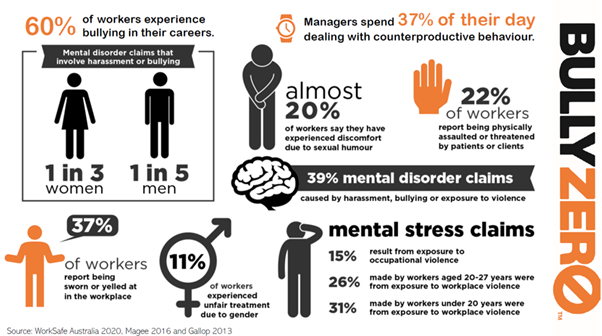
“The reality is most Australians will personally experience or witness workplace bullying at some point during their career, contributing to over a third of Australia’s mental health claims and up to $36 billion per year economically.” – Beyond Blue
Beyond Blue reports that almost 50% of all working Australians will experience bullying at some point in their work life. The knock-on effect of these health impacts vary, but they can impact both the individual and/or the workplace negatively. Bullying can have significant, serious effects on physical and mental health that may include:
- Stress
- Anxiety
- Depression
- PTSD
- Feeling physically sick before or at work
- Digestive issues
- Panic attacks
- Affected cognitive ability to make decisions
- High blood pressure
- Poor sleep or disturbed sleep quality
- Physical pain
- Headaches or migraines
- Increased risk of developing chronic conditions such as type 2 diabetes
- Loss of interest in work and other activities outside of work
- Low self-esteem or self-doubt
- Suicidal thoughts
Workplace effects can also include:
- Financial costs from legal proceedings, workers’ compensation claims, absenteeism or overall loss
- Loss of staff or poor ongoing retention of staff
- Increase in employee turnover rates
- Decrease in productivity or morale
- Poor reputation for the company
How can exercise assist with mental health?
Exercise can be used to help workers experiencing bullying by increasing both their physical and mental wellbeing. It can assist with:
- Building resilience
- Minimising the effects of stress, depression, anxiety and PTSD
- Facilitate a faster durable return to work outcome
- Providing as a distraction tool from worry
- Provide supportive social connectedness
- Improving and regulating mood
- Improving motivation, focus and attention
- Facilitating a sense of belonging
- Building an effective routine
- Building self-efficacy and a sense of control
Being active can improve the way in which your body handles stress. It can do this through a change in hormone responses, with the release of specific neurotransmitters called dopamine and serotonin (“the happy hormones”). Unfortunately, prolonged stress can have negative side effects on our body’s cardiovascular system, immune system and more. However, we know through an abundance of research that exercise can strengthen our immune system and is instrumental in protecting our cardiovascular health. In fact, exercise has a positive influence on all our bodily systems.
What forms of exercise are best?
An Accredited Exercise Physiologist (AEP) can be a useful resource in providing guidance and reassurance with exercise. Research suggests that not one form of exercise is more beneficial than another; instead, it is important to focus on exercise that is enjoyable for the individual.
The National Physical Activity Guidelines for Australians recommend a minimum of 30 minutes of moderate intensity exercise on most days. However, understanding the complexities that come with poor mental health – in particular, reduced motivation and feeling fatigued, achieving these recommendations can be daunting and even seem unachievable. It is important to note that a little activity is better than none, and more is better than a little. Undertaking small bouts of exercise may be more achievable, assisting in making up the requisite total 30 minutes, which in turn can lead to increased motivation.
Research supports the benefits for mental health in both aerobic (cardio) and resistance (strength) training. While the intensity of the exercise undertaken can play a role in these improvements, maintaining a regular routine with exercise is one of, if not the most, crucial factors when it comes to choosing the type of exercise. Research has also suggested that green exercise can also be beneficial in increasing one’s physical and mental health. The well-established effects of green exercise are such that participants report positive engagement, feeling revitalised, and state that they are more likely to exercise again. Best of all, green exercise is free and accessible to all!
References:
- Australian Human Rights Commission. What is bullying? Viewed November 28 2022, https://humanrights.gov.au/our-work/commission-general/what-bullying-violence-harassment-and-bullying-fact-sheet
- Heads Up. Workplace Bullying. Viewed 28 November 2022, https://www.headsup.org.au/supporting-others/workplace-bullying
- SafeWork Australia. Infographic: Workplace Bullying and Violence. Viewed November 28 2022, https://www.safeworkaustralia.gov.au/resources-and-publications/infographic/infographic-workplace-bullying-and-violence
- Jackson E (2013) Stress Relief: The role of exercise in stress management. ACSM Health and Fitness. 17(3).
- Schuch, F. B., & Stubbs, B. (2019). The Role of Exercise in Preventing and Treating Depression. Current sports medicine reports.
- Schuch, F. B., et al (2016). Exercise for depression in older adults: a meta-analysis of randomized controlled trials adjusting for publication bias.
- Department of Health. Australia’s Physical Activity and Sedentary Behaviour Guidelines. Canberra, Australia: Department of Health; 2014 [updated 2017]. Available from: http://www.health.gov.au/internet/main/publishing.nsf/Content/health-pubhlth-strateg-phys-act-guidelines.
- Department of Health 2019. Australia’s Physical Activity and Sedentary Behaviour Guidelines and the Australian 24-Hour Movement Guidelines. Canberra: Department of Health. Viewed 20 November 2020, https://www1.health.gov.au/internet/main/publishing.nsf/Content/health-pubhlth-strateg-phys-actguidelines.
- Brown WJ, Bauman AE, Bull FC & Burton NW 2012. Development of evidence-based physical activity recommendations for adults (18–64 years). Canberra: Department of Health.


